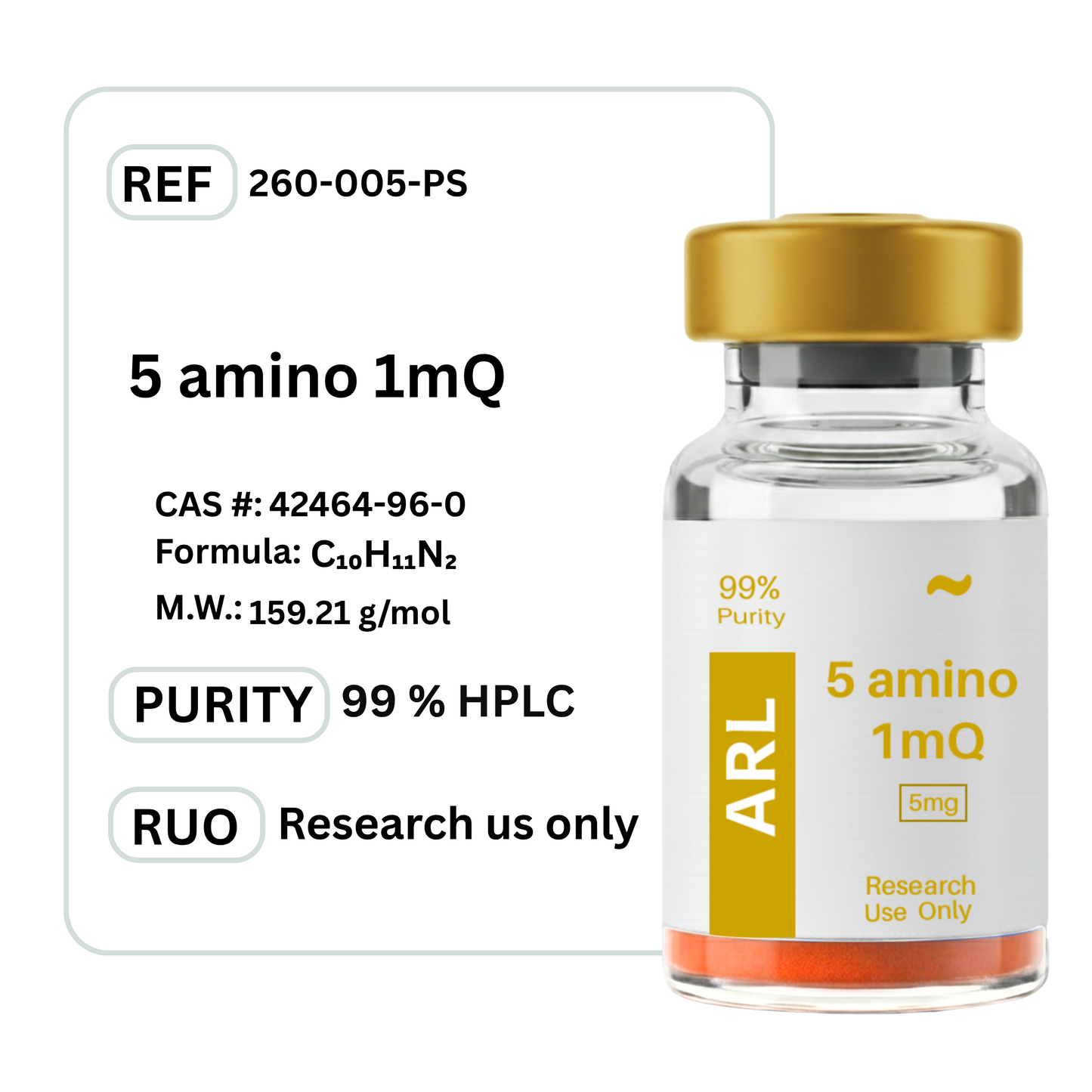
5-Amino-1MQ
5-Amino-1MQ
This batch of 5-Amino-1MQ Peptide has been third party lab tested and verified for quality.
Contents: 5-Amino-1-Methylquinolinium
Form: Powder
Purity: 99.6%
Couldn't load pickup availability
Free Reconstitution Solution automatically added to your cart with each order.
This product is Made, Tested & Shipped From United States.
Shipping & Delivery
We are committed to delivering fast, reliable, and transparent shipping for all orders. Please review our policy below for details on delivery times, tracking, and what to expect with every purchase.
View Full Shipping Policy
Verified+

Background on 5-Amino-1MQ
The compound 5-amino-1methylquinolinium (abbreviated 5-amino-1MQ) is a structurally small analogue of methylquinolinium that operates as a selective inhibitor of cytosolic nicotinamide N-methyltransferase (NNMT), a peptide-based enzyme. Scientific investigations have linked NNMT enzyme activity to metabolic disorders such as excess weight and type 2 diabetes, with this enzyme serving a critical function in how cells balance energy. Blocking NNMT produces remarkable outcomes: significant weight reduction, decreased fat mass and reduced adipocyte dimensions, alongside improved cholesterol and glucose plasma markers. Currently, researchers are studying 5-amino-1MQ and related methylquinolinium compounds as promising therapeutic options for weight control and diabetes management. Evidence also points to NNMT inhibition potentially activating stem cells and enhancing regenerative capabilities in skeletal muscle tissue.
5-Amino-1MQ Chemical Properties
Molecular Formula: C₁₀H₁₁N₂
Molecular Weight: 159.21 g/mol
Source: pubchem
Research Investigations into 5-Amino-1MQ
Weight Management Applications
We presently confront a worldwide health challenge with obesity, a condition initially found in affluent nations but now widespread globally across both men and women. Research across many studies demonstrates that elevated NNMT concentrations correlate with metabolic disturbances. Scientists have linked this enzyme to lipid storage mechanisms and diabetes advancement. Animal research reveals that mice generating high GLUT4 levels maintain leaner physiques, better health, and enhanced insulin sensitivity. Conversely, diabetic mice with elevated fat content and low GLUT4 levels exhibit profound insulin resistance.
Mouse model studies indicate that surplus body weight stems from metabolic imbalance and abnormally elevated NNMT enzyme concentrations, promoting moderate weight accumulation. This elevation stimulates NAD+ (Nicotinamide Adenine Dinucleotide) production while reducing GLUT4 requirements. When GLUT4 levels decline, insulin resistance emerges, hastening weight accumulation and obesity. Studies report that in subjects displaying weight gain, NNMT
inhibition demonstrates therapeutic potential for weight management. Research involving diabetic and obese mice with diminished GLUT4 levels shows improved outcomes following treatment with NNMT inhibitors, even in animals with natural resistance. Targeting this biological pathway has demonstrated progress in managing obesity and insulin resistance, consequently affecting diabetes. In one experiment, overweight rodents exposed to NNMT inhibitory compounds displayed all characteristics of metabolic excellence. Human metabolism typically operates with remarkable efficiency. Unfortunately, this efficiency may paradoxically work against efforts to reduce weight gain, making interventions more challenging when caloric consumption exceeds requirements. Comprehending the genetic and molecular foundations of our tendency toward obesity during excessive caloric intake will likely reveal additional causal factors. Reducing NNMT, given its connection with GLUT4, may constitute the missing link researchers have been seeking.
Fundamentally, NNMT determines the rate at which the body processes calories, thus affecting their availability for storage as fat or glycogen. Reducing NNMT activity increases inhibition of this enzyme, resulting in SAM (S-adenosyl methionine) utilization through alternative metabolic pathways. This generates two metabolic effects:
[DIAGRAM: Metabolic pathway depicting NAD+, NNMT, SAM interactions and their effects on fat storage and insulin]
Source: Science Brief
The overall result of administering an NNMT blocker like 5-amino-1MQ involves enhancing metabolic efficiency while reducing energy storage capacity. Combined with SAM's role in various cellular aging processes, this offers another compelling rationale for improvements in glucose handling and blood parameters. Research has additionally uncovered potential advantages for liver health and energy production. In rat studies, white adipose tissue (WAT) decreased by approximately 3%, with cholesterol reductions of about 7% over seven weeks. NAD+ levels increased by 3-7% from 5-amino-1MQ administration within 30 days without dietary changes—indicating mice maintained normal eating patterns while demonstrating improved body composition concerning stored adipose tissue. After six weeks, these animals exhibited various metabolic enhancements including increased insulin sensitivity via elevated action of factors like PPAR-alpha, which promotes fat turnover and cellular renewal.
Source: Science Brief
Specialized lipids known as FAHFAs (fatty acid hydroxyl fatty acids) enhance insulin sensitivity and facilitate glucose uptake into muscle cells through PPAR-alpha signaling pathways. Critical evidence indicates that 5-amino-1MQ's effects may exceed its ability to downregulate NNMT, additionally increasing insulin action and cellular glucose uptake by: (1) elevating NAD+ molecules that enable cells to produce an alternative lipid class possessing remarkable anti-diabetic and anti-inflammatory properties.
Effects on Muscle Tissue
The effects of 5-amino-1MQ on skeletal muscle are multifaceted. Similar to its actions in adipose tissue, this compound influences muscle energetics and may promote mitochondrial generation (cellular energy powerhouses).
Recent investigations suggest that NNMT inhibition through any approach, including 5-amino-1MQ, may directly impact muscle structure and function.
Research involving mice treated for merely four weeks with an NNMT inhibitor demonstrated considerable muscle cell activation throughout the body, stimulating muscle growth proteins. When subjected to NNMT inhibition, aging muscles exhibited remarkably increased muscle protein content—approximately 70% elevation in some instances. More notably, these changes began within days of 5-amino-1MQ administration, indicating rapid activation of muscle-building processes even in diabetic animals.
These findings revealed elevated NAMPT levels, and reducing NNMT concentrations produces more significant impacts on fat mass. By enhancing cellular vitality and decreasing activation of sarcopenic (muscle-degrading) proteins like ubiquitin ligase MuRF1, NNMT inhibition assists aging and diabetic animals in maintaining and repairing muscle tissue. This stimulation helps individuals preserve their existing muscle mass, suggesting potential applications in treating conditions such as muscular dystrophy and age-related muscle wasting.
The exact mechanisms by which NNMT inhibitors impact muscle function remain incompletely elucidated, though another factor appears related to NAD+ levels. Recall that NAD+ functions as a catalyst for numerous cellular processes. Compounds like 5-amino-1MQ have demonstrated improvements in muscle function, cardiac health, and IGF1 levels across multiple studies, beyond the metabolic effects observed in mice. These models and earlier investigations suggest that 5-amino-1MQ's benefits, including NAD+ level increases, represent one of several beneficial compound classes.
Potential Cognitive Benefits
NNMT plays a crucial role in cellular energy expenditure. NAD+ depletion has been demonstrated to impair brain energy metabolism, resulting in cognitive decline. Studies reveal deficits in neurogenesis (new neuron development) and diminished synaptic function at neuromuscular junctions where neurons connect to muscle fibers. Mouse research indicates that NAD+ inhibition produces severe failures across various brain regions, resulting in significant cognitive function loss.
While 5-amino-1MQ has not been specifically tested in cognitive contexts, strong reasons exist to believe this compound, through its NAD+-related effects, may provide benefits. More significantly, evidence exists that restoring NAD+ to neuronal structures produces improvements in cognitive dysfunction and potential enhancements in overall brain cognitive function. Studies also suggest brain health benefits, though comprehensive understanding remains to be established. Strong rationale exists for exploring the potential cognitive benefits of 5-amino-1MQ.
Significant research suggests that NNMT expression is elevated in gastric cancer.
5-Amino-1MQ Conclusion
5-amino-1MQ represents a groundbreaking compound that inhibits the nicotinamide N-methyltransferase enzyme. Animal model studies demonstrate substantial weight reduction and preferential fat loss. NNMT associates with metabolic diseases including obesity and diabetes; therefore, inhibiting NNMT with 5-amino-1MQ produces weight reduction, diminished adiposity, and improved metabolic function. Laboratory animal research demonstrates that NNMT inhibition with 5-amino-1MQ generates significant body composition changes throughout treatment—resulting in weight loss and enhanced muscle function. Hope exists that compounds like 5-amino-1MQ may contribute to treating conditions such as muscular dystrophy and age-related muscle wasting.
In summary, 5-amino-1MQ is a selective NNMT inhibitor demonstrating excellent promise as research continues advancing our understanding of obesity treatment and metabolic disease management.
-

PRECISION ENGINEERING
Formulated in cGMP-compliant manufacturing centers.
-

ELEVATED SERVICE
Quick and reliable 3-5 day delivery.
-

GUIDING LIGHT
Expert peptide support available continuously.
You may also like
-
SAVE 25%Tirzepatide
Regular price From $50.00Regular price From $50.00 Sale priceUnit price / per$67.0025% -
SAVE 24%Thymosin Alpha-1
Regular price From $79.00Regular price From $79.00 Sale priceUnit price / per$104.0024% -
SAVE 23%Tesamorelin
Regular price From $80.00Regular price From $80.00 Sale priceUnit price / per$105.0023% -
SAVE 23%Survodutide
Regular price $299.00Regular price $299.00 Sale priceUnit price / per$392.0023% -
SAVE 26%Sterile Water
Regular price From $14.00Regular price From $14.00 Sale priceUnit price / per$19.0026% -
SAVE 23%SLU-PP-332
Regular price $125.00Regular price $125.00 Sale priceUnit price / per$164.0023% -
SAVE 23%Sermorelin
Regular price From $70.00Regular price From $70.00 Sale priceUnit price / per$92.0023% -
SAVE 23%Semaglutide
Regular price From $36.00Regular price From $36.00 Sale priceUnit price / per$47.0023% -
SAVE 23%Retatrutide Triple Agonist
Regular price From $90.00Regular price From $90.00 Sale priceUnit price / per$118.0023% -
SAVE 26%Oxytocin Acetate
Regular price $42.00Regular price $42.00 Sale priceUnit price / per$57.0026% -
SAVE 25%Melanotan II (MT2)
Regular price $50.00Regular price $50.00 Sale priceUnit price / per$67.0025% -
SAVE 24%Lipo-C with B Vitamins
Regular price $85.00Regular price $85.00 Sale priceUnit price / per$112.0024% -
SAVE 23%Lemon Bottle
Regular price $80.00Regular price $80.00 Sale priceUnit price / per$105.0023% -
SAVE 24%KPV Tripeptide
Regular price From $56.00Regular price From $56.00 Sale priceUnit price / per$74.0024% -
KLOW Blend - GHK-CU + TB-500 + BPC-157 + KPV 10mg
Regular price $200.00Regular price $200.00 Sale priceUnit price / per$261.0023% -
SAVE 23%Kisspeptin-10
Regular price From $65.00Regular price From $65.00 Sale priceUnit price / per$85.0023% -
SAVE 23%Ipamorelin
Regular price From $32.00Regular price From $32.00 Sale priceUnit price / per$42.0023% -
SAVE 24%IGF-1 LR3 (Long R3)
Regular price From $40.00Regular price From $40.00 Sale priceUnit price / per$53.0024% -
SAVE 24%Hyaluronic
Regular price $28.00Regular price $28.00 Sale priceUnit price / per$37.0024% -
SAVE 23%HGH Fragment 176-191
Regular price $97.00Regular price $97.00 Sale priceUnit price / per$127.0023% -
SAVE 23%HGH 191AA (Somatropin)
Regular price From $55.00Regular price From $55.00 Sale priceUnit price / per$72.0023% -
SAVE 25%Gonadorelin
Regular price $50.00Regular price $50.00 Sale priceUnit price / per$67.0025% -
SAVE 23%Glutathione
Regular price $83.00Regular price $83.00 Sale priceUnit price / per$109.0023% -
SAVE 23%Glow BPC-157 + GHK-CU + TB-500
Regular price $139.00Regular price $139.00 Sale priceUnit price / per$181.0023% -
SAVE 25%Epitalon (Epithalon)
Regular price From $50.00Regular price From $50.00 Sale priceUnit price / per$67.0025% -
SAVE 24%Dermorphin
Regular price $56.00Regular price $56.00 Sale priceUnit price / per$74.0024% -
SAVE 23%CJC-1295 with DAC
Regular price $139.00Regular price $139.00 Sale priceUnit price / per$182.0023% -
SAVE 23%CJC-1295 No DAC & Ipamorelin
Regular price $95.00Regular price $95.00 Sale priceUnit price / per$124.0023%
Every vial we sell comes from a lab that follows current Good Manufacturing Practices (cGMP). That means each step of production is documented and controlled. Before a batch is released, it’s tested by independent third-party labs for purity, identity, and sterility. Certificates of analysis are available so you can see the exact test results.
Yes. The labs we work with use ISO-certified clean rooms where air quality, equipment, and handling procedures are tightly regulated. Staff are trained to pharmaceutical-grade standards. This ensures the peptides are produced in an environment that minimizes contamination risks.
Peptides in lyophilized (freeze-dried) form are stable at room temperature for transport. Once you receive them, refrigeration is recommended to maintain long-term integrity. We package every order securely to prevent damage and ship promptly, so your vials arrive in optimal condition.
We operate under strict in-house protocols that follow current Good Manufacturing Practices (cGMP). That means our team oversees the entire process from sourcing raw amino acids to the final lyophilized vial. Nothing is outsourced or repackaged. This gives us full control over purity, consistency, and sterility, and it’s why we can stand behind every single vial we ship.
Store them in the refrigerator, away from direct light and heat. If you need to keep them longer, some peptides can be stored frozen. Each vial comes with clear handling instructions so you know the proper conditions for stability.
The strongest proof is transparency. For every peptide, we can provide certificates of analysis, manufacturing documentation, and references to the published scientific research behind it. If you ever have questions, we’ll show you the data rather than ask you to take our word for it.
The difference is transparency. Most sites give you a product name and a price. We provide full batch testing, lab documentation, and direct access to certificates of analysis so you don’t have to guess what you’re getting. When you order from us, you know exactly what’s in the vial, where it was made, and how it was verified.