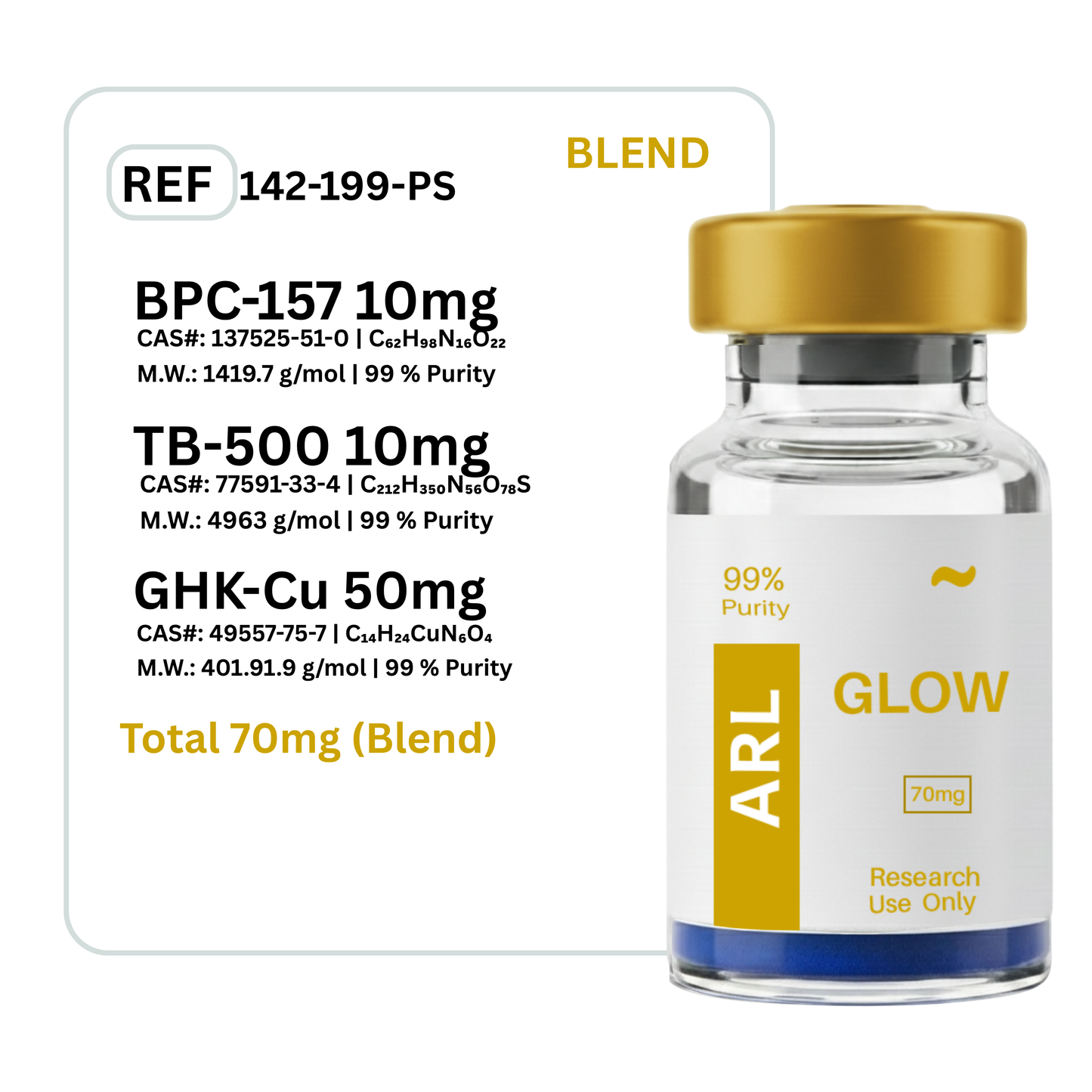
Glow BPC-157 + GHK-CU + TB-500
This batch of Glow BPC-157 + GHK-CU + TB-500 Peptide Blend has been third party lab tested and verified for quality.
Contents: BPC-157 (Body Protection Compound), GHK-Cu (Copper Tripeptide-1), and TB-500 (Thymosin Beta-4 Fragment)
Form: Powder
Purity: 99.3%
Couldn't load pickup availability
Free Reconstitution Solution automatically added to your cart with each order.
This product is Made, Tested & Shipped From United States.
Ships Today
Order by 1:00 PM EST
Free Shipping
For 2 or more vials
Verified+

Investigative Framework: BPC-157, TB500, and GHK-Cu Synergistic Effects in Tissue Regeneration Models
Research Rationale and Hypothesis
Primary Hypothesis: Concurrent administration of BPC-157, TB500, and GHK-Cu produces synergistic effects on tissue regeneration metrics and inflammatory markers exceeding effects of individual compounds or any two-compound combinations.
Secondary Hypotheses:
- Combined administration achieves superior inflammatory suppression through multi-pathway convergence
- Fibroblast proliferation and collagen deposition increase non-additively with combined therapy
- Antimicrobial efficacy and infection prevention demonstrate synergistic enhancement
- Oxidative stress markers decline non-linearly with combined administration
Methodological Framework
Study Design: Controlled experimental investigation comparing:
- Vehicle control (baseline tissue response)
- Individual peptide administration (BPC-157 alone, TB500 alone, GHK-Cu alone)
- Dual combinations (BPC-157 + TB500, BPC-157 + GHK-Cu, TB500 + GHK-Cu)
- Triple combination (all three peptides)
Model Systems:
- Primary dermal and tendon fibroblast cultures for in vitro mechanistic studies
- Full-thickness wound models in rodents for in vivo kinetic assessment
- Tendon injury models for musculotendinous application validation
- Cardiac ischemia-reperfusion models for regeneration assessment
Dosing Strategy and Pharmacokinetics
Dose Selection Rationale: Individual IC50 values and ED50 values from literature inform selection. Initial combination ratios employ equimolar concentrations based on individual effective doses, with subsequent optimization through factorial experimental design.
Dosing Schedule:
- Single acute administration for immediate response kinetics
- Repeated administration (24h intervals × 3) for sustained effect assessment
- Timed administration relative to injury induction
- Dose escalation studies for optimal effect determination
Pharmacokinetic Assessment:
- Radiolabeled peptide tracking for tissue distribution kinetics
- HPLC analysis for plasma clearance curves
- Tissue concentration measurements via mass spectrometry
- Distribution pattern comparison across tissues
Molecular Markers and Measurement Endpoints
Primary Inflammatory Markers:
- TNF-α, IL-1β, IL-6 quantification via ELISA
- NF-κB activation status through Western blotting
- Oxidative stress markers (ROS, MDA, protein carbonyls)
- Antioxidant enzyme activity (SOD, catalase, glutathione peroxidase)
Tissue Regeneration Markers:
- Fibroblast proliferation via MTT assay and live cell counting
- Collagen deposition quantified through hydroxyproline measurement
- Matrix metalloproteinase activity via zymography
- TIMP expression through qRT-PCR
- Angiogenic factor expression (VEGF, FGF, angiopoietin-1)
Mechanistic Targets:
- NOS enzyme expression and activity measurement
- eNOS phosphorylation status (activity indicator)
- PI3K/Akt phosphorylation cascades
- Notch pathway activation assessment
- Wnt signaling component expression
- TGF-β/SMAD pathway activation
Gene Expression Analysis:
- RNA-seq for global transcriptomics revealing pathway interactions
- qRT-PCR validation of key targets
- Temporal expression patterns following treatment
- Single-cell RNA-seq for cell-type specific responses
Functional Outcome Measures
Wound Healing Models:
- Closure rate measurements (digital image analysis)
- Neo-epithelialization timeline
- Collagen organization and maturation assessment via histology
- Mechanical strength testing of healed tissue
- Microvascular density measurement
- Scar tissue formation quantification
Tendon Models:
- Tensile strength and elastic modulus
- Load-to-failure testing
- Collagen fiber alignment organization
- Cellular infiltration patterns
- Vascularity restoration timeline
- Functional mobility metrics
Infection Models:
- Bacterial burden quantification over time
- Macrophage infiltration and activation status
- Antimicrobial peptide production
- Biofilm formation prevention
- Wound fluid antibiotic penetration
Statistical Analysis Framework
Synergy Assessment:
- Bliss independence criterion: comparing observed vs. predicted additive effects
- Loewe additivity model application
- Combination index calculations
- Isobologram construction for dose-effect relationships
Statistical Tests:
- Two-way ANOVA for single vs. combination comparisons
- Repeated measures ANOVA for temporal analyses
- Bonferroni correction for multiple comparisons
- Non-parametric tests where normality assumptions violated
- Mixed-effects modeling for hierarchical data structures
Power Analysis: Minimum n-values determined through power analysis targeting 80% power, α=0.05 for detecting 30% effect size differences between single and combined treatments.
Expected Outcomes and Interpretation Framework
Synergy Evidence: Observable outcomes suggesting synergistic interaction:
- Combined effects exceed 130-150% of largest single peptide effect
- Gene expression patterns differ qualitatively between single and combined administration
- Temporal dynamics show accelerated progression with combined therapy
- Inflammatory resolution proceeds more rapidly and completely
Additive Effects: If effects sum linearly:
- Combined outcomes approximate sum of individual effects
- Gene expression patterns represent composite of individual responses
- No non-linear temporal dynamics
- Suggests potential redundancy or compensatory mechanisms
Antagonistic Effects: If effects prove less than additive:
- Competitive interactions for common cellular targets
- Potential feedback inhibition between pathways
- Sequential administration testing required
Translational Implications
Positive Synergy Results Enable:
- Dose reduction of individual peptides through combination (reduced cost, potential toxicity)
- Superior clinical outcomes with same total peptide quantity
- Broader mechanistic coverage reducing compensatory pathway activation
- Foundation for clinical trial design with optimized dosing
Additive Results Indicate:
- Independent pathway engagement without convergence
- Potential for sequential rather than combined administration
- Possible single-agent preference based on indication-specific factors
- Need for mechanistic refinement studies
Quality Control and Validation Parameters
Peptide Characterization:
- HPLC purity assessment (≥95% required)
- Mass spectrometry confirmation of molecular weight
- Endotoxin testing (LAL assay)
- Sterility and microbial contamination assessment
- Stability testing under proposed storage conditions
Experimental Validation:
- Positive control substances with known mechanisms
- Dose-response curve generation for EC50 determination
- Reproducibility assessment across experimental batches
- Blinded experimental conduct and analysis
- Independent verification of key findings
Publication and Reporting Standards
- ARRIVE guidelines compliance for animal studies
- CONSORT guidelines for controlled study reporting
- Pre-registration of hypothesis and analysis plan
- Transparent reporting of all results including negative findings
- Detailed supplementary material with raw data availability
-
check_circle
HIGHEST QUALITY PEPTIDES
Our products are scientifically formulated and manufactured in cGMP-compliant facilities.
-
encrypted
FAST DELIVERY
Enjoy fast and reliable 3–5 day shipping.
-
check_circle
Dedicated Customer Service
Our customer service team is highly knowledgeable in peptide research and its applications. We’re available 24/7 to assist you.
Verified reviews
Tested. Verified. Trusted.
We take a laboratory-first approach to quality. Each batch is made under controlled conditions and verified by an independent lab (HPLC/MS). We only ship batches that test ≥99% purity, and we provide a full COA, including identity, methods, and chromatograms, for your review.
You may also like
-
SAVE 25%Tirzepatide
Regular price From $50.00Regular price From $50.00 Sale priceUnit price / per$67.0025% -
SAVE 24%Thymosin Alpha-1
Regular price From $79.00Regular price From $79.00 Sale priceUnit price / per$104.0024% -
SAVE 23%Tesamorelin
Regular price From $80.00Regular price From $80.00 Sale priceUnit price / per$105.0023% -
SAVE 23%Survodutide
Regular price $299.00Regular price $299.00 Sale priceUnit price / per$392.0023% -
SAVE 26%Sterile Water
Regular price From $14.00Regular price From $14.00 Sale priceUnit price / per$19.0026% -
SAVE 23%SLU-PP-332
Regular price $125.00Regular price $125.00 Sale priceUnit price / per$164.0023% -
SAVE 23%Sermorelin
Regular price From $70.00Regular price From $70.00 Sale priceUnit price / per$92.0023% -
SAVE 23%Semaglutide
Regular price From $36.00Regular price From $36.00 Sale priceUnit price / per$47.0023% -
SAVE 23%Retatrutide Triple Agonist
Regular price From $90.00Regular price From $90.00 Sale priceUnit price / per$118.0023% -
SAVE 26%Oxytocin Acetate
Regular price $42.00Regular price $42.00 Sale priceUnit price / per$57.0026% -
SAVE 25%Melanotan II (MT2)
Regular price $50.00Regular price $50.00 Sale priceUnit price / per$67.0025% -
SAVE 24%Lipo-C with B Vitamins
Regular price $85.00Regular price $85.00 Sale priceUnit price / per$112.0024% -
SAVE 23%Lemon Bottle
Regular price $80.00Regular price $80.00 Sale priceUnit price / per$105.0023% -
SAVE 24%KPV Tripeptide
Regular price From $56.00Regular price From $56.00 Sale priceUnit price / per$74.0024% -
KLOW Blend - GHK-CU + TB-500 + BPC-157 + KPV 10mg
Regular price $200.00Regular price $200.00 Sale priceUnit price / per$261.0023% -
SAVE 23%Kisspeptin-10
Regular price From $65.00Regular price From $65.00 Sale priceUnit price / per$85.0023% -
SAVE 23%Ipamorelin
Regular price From $32.00Regular price From $32.00 Sale priceUnit price / per$42.0023% -
SAVE 24%IGF-1 LR3 (Long R3)
Regular price From $40.00Regular price From $40.00 Sale priceUnit price / per$53.0024% -
SAVE 24%Hyaluronic
Regular price $28.00Regular price $28.00 Sale priceUnit price / per$37.0024% -
SAVE 23%HGH Fragment 176-191
Regular price $97.00Regular price $97.00 Sale priceUnit price / per$127.0023% -
SAVE 23%HGH 191AA (Somatropin)
Regular price From $55.00Regular price From $55.00 Sale priceUnit price / per$72.0023% -
SAVE 25%Gonadorelin
Regular price $50.00Regular price $50.00 Sale priceUnit price / per$67.0025% -
SAVE 23%Glutathione
Regular price $83.00Regular price $83.00 Sale priceUnit price / per$109.0023% -
SAVE 23%Glow BPC-157 + GHK-CU + TB-500
Regular price $139.00Regular price $139.00 Sale priceUnit price / per$181.0023% -
SAVE 25%Epitalon (Epithalon)
Regular price From $50.00Regular price From $50.00 Sale priceUnit price / per$67.0025% -
SAVE 24%Dermorphin
Regular price $56.00Regular price $56.00 Sale priceUnit price / per$74.0024% -
SAVE 23%CJC-1295 with DAC
Regular price $139.00Regular price $139.00 Sale priceUnit price / per$182.0023% -
SAVE 23%CJC-1295 No DAC & Ipamorelin
Regular price $95.00Regular price $95.00 Sale priceUnit price / per$124.0023%
Every vial we sell comes from a lab that follows current Good Manufacturing Practices (cGMP). That means each step of production is documented and controlled. Before a batch is released, it’s tested by independent third-party labs for purity, identity, and sterility. Certificates of analysis are available so you can see the exact test results.
Yes. The labs we work with use ISO-certified clean rooms where air quality, equipment, and handling procedures are tightly regulated. Staff are trained to pharmaceutical-grade standards. This ensures the peptides are produced in an environment that minimizes contamination risks.
Peptides in lyophilized (freeze-dried) form are stable at room temperature for transport. Once you receive them, refrigeration is recommended to maintain long-term integrity. We package every order securely to prevent damage and ship promptly, so your vials arrive in optimal condition.
We operate under strict in-house protocols that follow current Good Manufacturing Practices (cGMP). That means our team oversees the entire process from sourcing raw amino acids to the final lyophilized vial. Nothing is outsourced or repackaged. This gives us full control over purity, consistency, and sterility, and it’s why we can stand behind every single vial we ship.
Store them in the refrigerator, away from direct light and heat. If you need to keep them longer, some peptides can be stored frozen. Each vial comes with clear handling instructions so you know the proper conditions for stability.
The strongest proof is transparency. For every peptide, we can provide certificates of analysis, manufacturing documentation, and references to the published scientific research behind it. If you ever have questions, we’ll show you the data rather than ask you to take our word for it.
The difference is transparency. Most sites give you a product name and a price. We provide full batch testing, lab documentation, and direct access to certificates of analysis so you don’t have to guess what you’re getting. When you order from us, you know exactly what’s in the vial, where it was made, and how it was verified.